The United States Must Not Withdraw from the
United Nations Framework Convention on Climate Change
On January 7, 2026, the White House issued a presidential memorandum directing federal departments and agencies to withdraw the United States from 66 international efforts. The listing included one treaty, the United Nations Framework Convention on Climate Change (“the treaty” or “UNFCCC”).
On February 27, 2026 the U.S. State Department notified the UNFCCC Secretariat that the United States withdraws. Pursuant to the treaty’s own terms, withdrawals take effect one year after notification. Here, that is Feb. 27, 2027.1
Withdrawal from the UNFCCC would be tragic for the world and self-defeating for the United States. Climate change endangers every nation, including the U.S.. Correlatively, GHG emissions from the U.S., over time, have contributed more to the overriding global problem than from any other nation. Further, unilateral withdrawal without congressional concurrence undermines democracy and climate security alike.
The UNFCCC aims “to protect the climate system for present and future generations,” in part by specifying the “interconnected obligations of result and conduct,”2 as a bellwether opinion of the International Court of Justice put it. Those legal obligations include, in Article 2, the duty of every nation to act to stabilize greenhouse gas (GHG) concentrations in the atmosphere “at a level that would prevent dangerous anthropogenic interference with the climate system.”
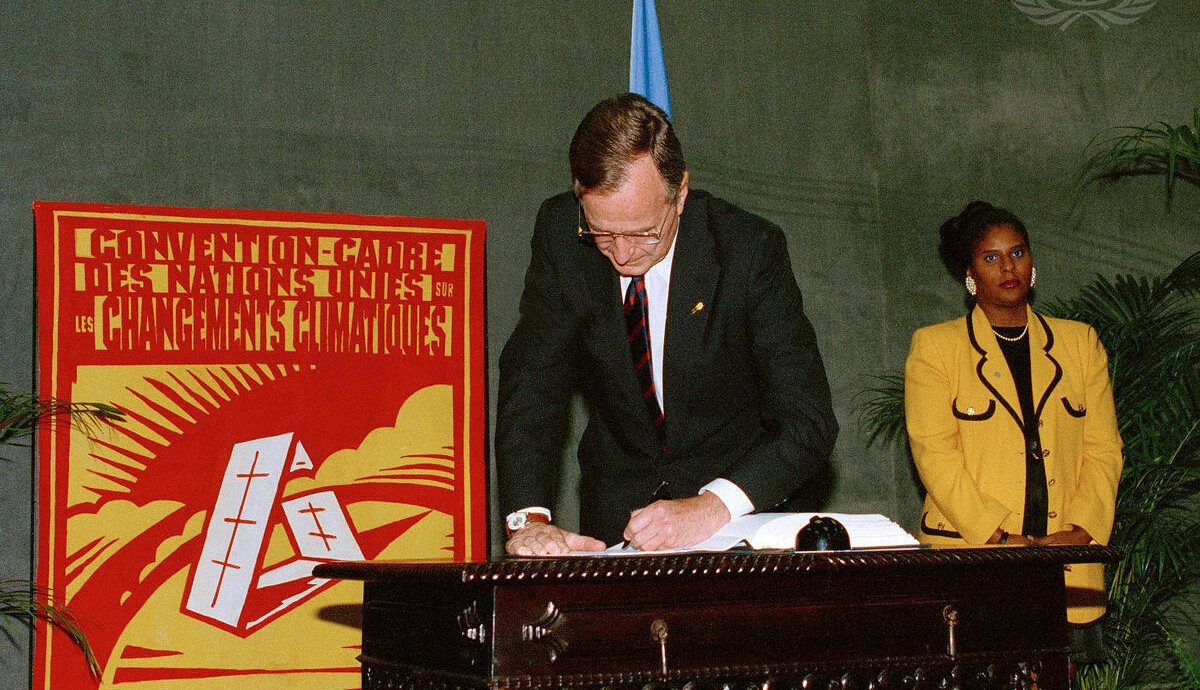
President George H. W. Bush signed the UNFCCC for the United States on June 12, 1992, and the U.S. Senate approved the treaty for ratification on October 7, 1992, by a margin of 92-0. Virtually every nation is a Party, and no nation, to date, has fully withdrawn.
Pursuant to the U.S. Constitution, treaties, along with statutes and constitutional provisions, comprise the Supreme Law of the Land, and the 1992 Senate concurrence authorized no later unilateral executive withdrawal.
Global action on climate is needed now more than ever, as the UNFCCC’s objective to stabilize atmospheric GHG concentrations at a safe level has not nearly been achieved. In consequence, regional and global warming has accelerated, extreme weather
events disrupt one region after another, and tipping points in critical human and natural systems rapidly approach.
The United States is hardly immune from severe climate impacts. Rising sea levels threaten U.S. coastal communities; the risk of severe wildfire, including urban conflagration, increases with temperature rise; and billion-dollar climate-fueled disasters nationwide have climbed markedly in recent decades.3
Impacts to human systems, including to public health and food production, along with the environment, will only mount unless the transition away from fossil fuels is accelerated, among other critical initiatives.
All signatory nations recognized, in the UNFCCC, that we can effectively confront the enveloping crisis only through “the widest possible cooperation by all countries and their participation in an effective and appropriate international response.”4
That principle still obtains.
The United States should remain-in and strengthen the UNFCCC — including through domestic action and international cooperation to phase out the production and use of coal, oil, and natural gas in energy systems, among other actions.5
Accordingly, the undersigned individuals and organizations, pursuant to their First Amendment right to seek a redress of grievances, hereby petition Congress seeking, at minimum, a Senate, House, or Joint Congressional Resolution.
The United States must remain-in, and not withdraw from the United Nations Framework Convention on Climate Change.
- C.N.102.2026.TREATIES-XXVII.7 (Depositary Notification)
- ICJ, Obligations of States in Respect of Climate Change (July 2025) at par. 204; CPR Initiative, When the Law Returns.
- C. Piecuch, The Rate of U.S. Coastal Sea-Level Rise Doubled in the Past Century (Dec. 17, 2025); IPCC AR6 Synthesis Report §3.1.2 at 71-74; NOAA, U.S. Billion-dollar Weather and Climate Disasters,1980 – present.
- UNFCCC, Preamble.
- UNFCCC COP 28 (2023) Decision, 1/CMA.5, II(A)(28)(d).


 Reload document
  Open in new tab