

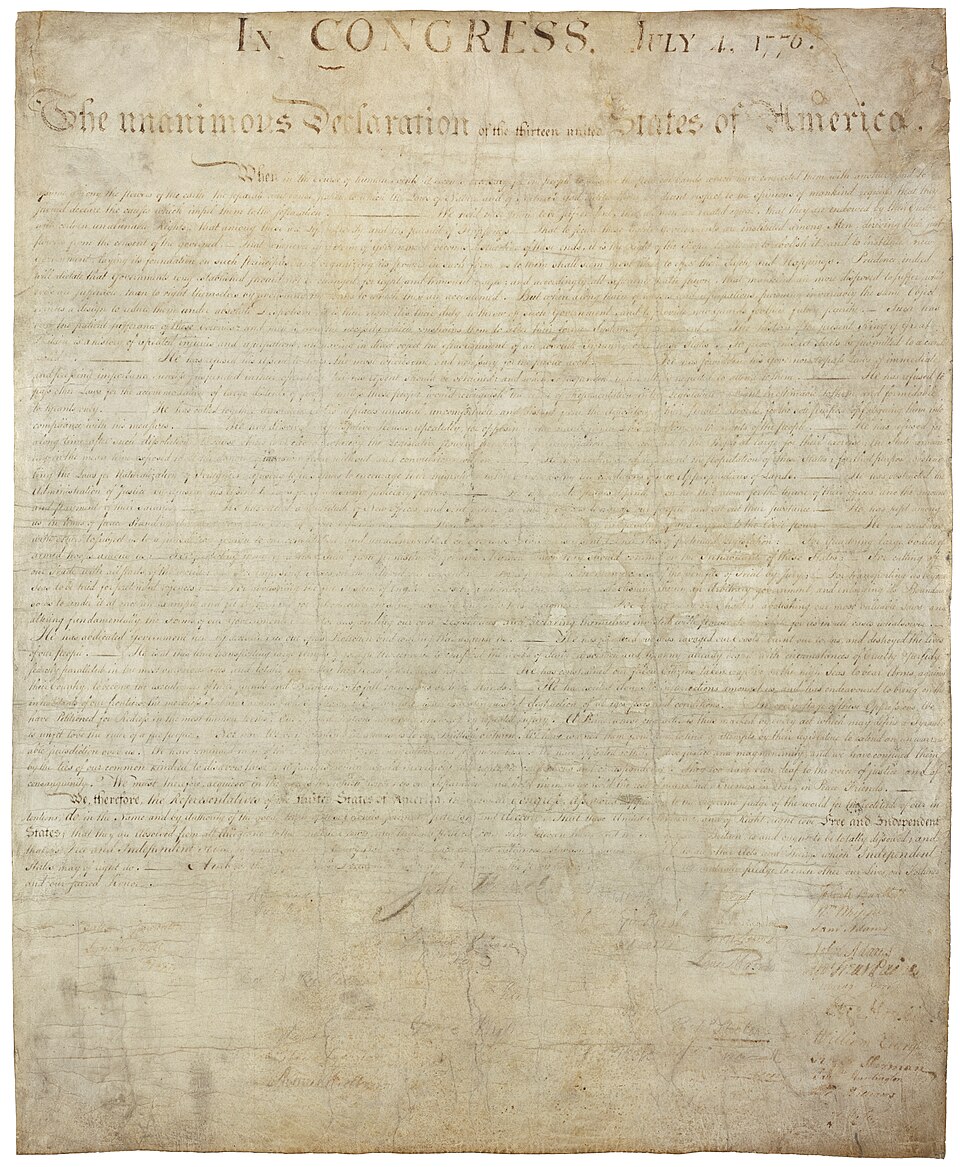
It was in their Declaration of Independence that our forebears asserted a right of The People not merely to “throw off such Government” that “reduces them under absolute Despotism,” but also to “institute new Government, laying its foundation on such principles and organizing its powers in such form, as to them shall seem most likely to effect their Safety and Happiness.”
Now, however, by and through their decision last week in Donald J. Trump v. Rebecca Kelly Slaughter, a majority of Justices on the Supreme Court took another major stride toward Absolutism, the will of The People be damned.
In brief, the Court majority held that Congress may not restrain a President’s unfettered right to remove the leadership of a federal agency (albeit with one exception, that is, with respect to the Federal Reserve).
In this space two years ago I reported on a case in which our Supreme Court, in a 6-3 decision, overturned a core precept of American democracy — that is, that no person is above the law. Virtually from whole cloth, the rightist majority determined that the President—indeed, any President—is cloaked in immunity from federal prosecution for crimes he (or she) may commit while in office.
See Now a King, Above the Law.
At the time, I commended to readers the powerful dissents of Justices Sonia Sotomayor and Ketanji Brown Jackson, “less because they foretell what will become of our Republic than what they reveal about our nation, at [that] time.”
It turns out, however, that the dissenting justices were more prescient than I imagined. In Slaughter, that self-same majority conferred on Trump “more expansive removal powers than those enjoyed by the Crown.” (Sotomayor dissent, see below, at 15.)
Commencing her dissent, Justice Sotomayor observed that:
For most of this Nation’s history, Congress and the President together have decided that some Government functions should operate at a distance from partisan politics. Those include the management of nuclear energy; the security of the monetary supply; and the safety of American workplaces, consumer products, and chemical hazards. In these and many other areas, the wisdom of the centuries has taught that some decisions should depend not only on who is in office—much less on who is disfavored or owed a favor by those in office—but also on judgment, expertise, and the public good.
“[Accordingly, s]ince the founding, Congress has created agencies that in various ways have embodied this goal of independence.”
Justice Sotomayor’s entire dissent is well worth reading, I think, in order to understand just how profoundly the Court’s majority in Slaughter has broken with precedent and the orderly administration of government.
But I also recognize that its reading may prove tough sledding for many. Accordingly, below her printed dissent I offer my own aloud reading of it, sans footnotes and citations so as to maintain its flow.
My reading of the dissent (leaving out citations and footnotes) (audio only).