

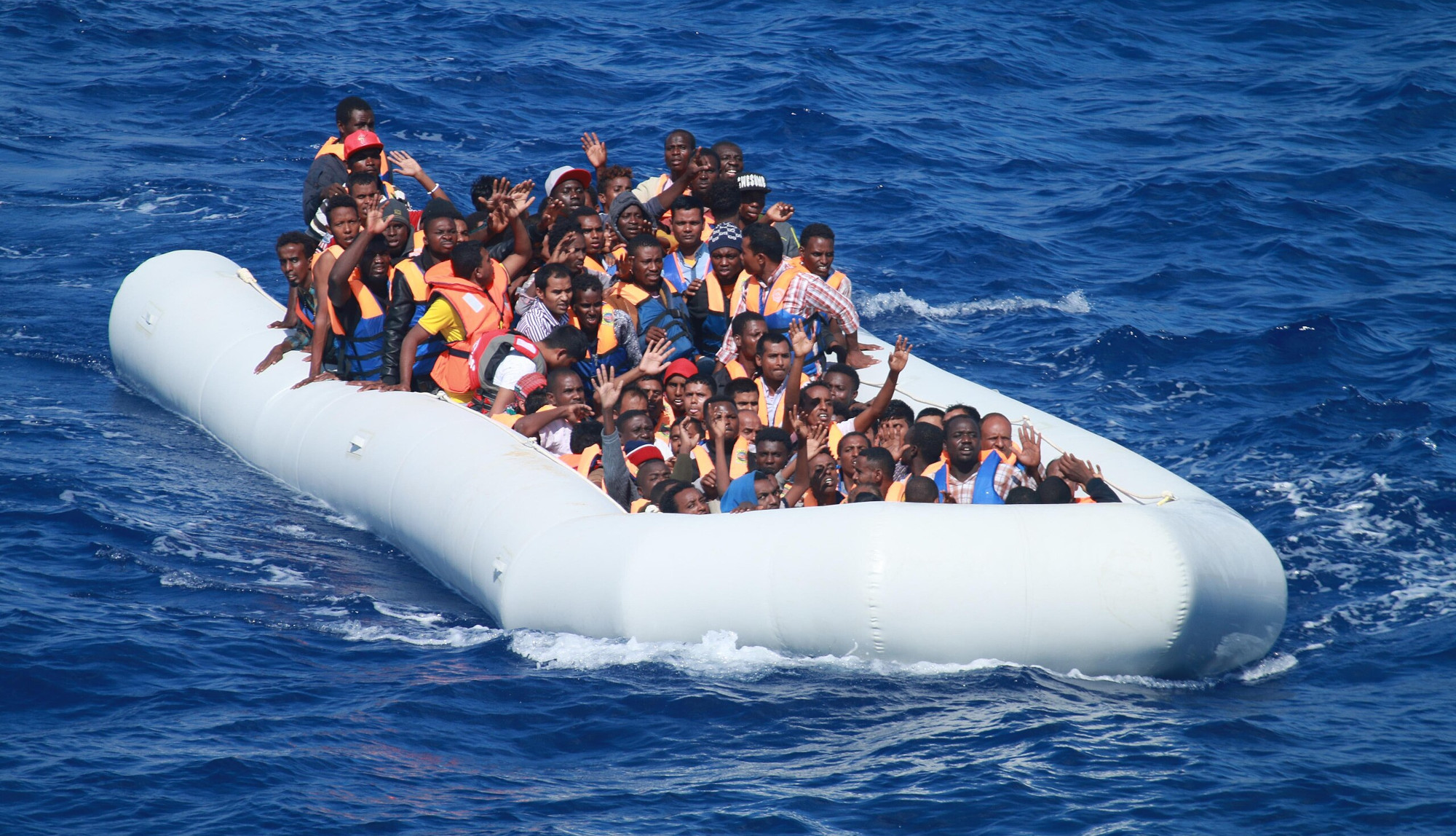
Note: Dr. Eelco J. Rohling is editor-in-chief of Oxford Open Climate Change, Professor at the Department of Earth Sciences, Utrecht University, NL, and a Member of the Board of Advisors of CPR Initiative. His editorial here was originally published in Oxford Open Climate Change (June 2025) as “The migration storm on the horizon.” We reprint it here with permission of the Journal and its Dr. Rohling.
Many governments today seem alarmed by a perceived crisis of migration pressure. Yet, there appears to be little political awareness of the massive global mass-migration pressure that is building because of deadly heat, drought, and associated water shortages and hunger. Heat impacts are felt immediately, while drought impacts accumulate over years to decades. These combined impacts will render large parts of the tropical and subtropical regions uninhabitable within decades, and at the same time seriously threaten global food security. This cocktail will increase migration pressure many times over, both directly and by fueling conflicts.
Global climate change
Satellite and surface measurements reveal accelerating global warming (e.g. 1, 2, 3). This can be extrapolated into the future using either complex climate models or straightforward statistical relationships, using different potential scenarios of population growth, economic development, energy use per capita, and climate-change mitigation strategies (e.g. 4). Uncertainties in both the scenarios and the extrapolation methods are incorporated in the resulting projections. Emissions scenarios can be broadly classed as optimistic, average, and pessimistic. Optimistic scenarios include rapid emissions reduction starting immediately, along with greenhouse gas removal to achieve net zero emissions at some time between 2050 and 2100. Average ones reach peak emissions by about 2040, followed by major emissions reduction along with greenhouse gas removal. Pessimistic scenarios include greenhouse gas emissions that continue to increase in a similarly rapid manner as they did until about 2015. Typically, these scenarios end up at roughly 2 °C, roughly 3 °C, and roughly 5 °C of warming by 2100, respectively (e.g. 5, 6). By about 2015, observed human-caused emissions dropped below the most pessimistic trajectories (7), and most likely warming by 2100 seems to be 3 °C across different economic assumptions (8).
No complicated climate models are needed for a decent indication of future global mean warming. Instead, we can use the historical, almost-linear, relationship between the sum of greenhouse gas emissions through time and global mean temperature change (e.g. 9, 10). Projected future emissions for each scenario are then added to the historical ones, and the results fed into the relationship to estimate the scenario’s global mean warming (with uncertainties). But climate models remain essential to reveal the associated patterns of temperature or drought around the world.
Temperature
There are serious worries about the development of long-lasting conditions of dangerous to lethal heat for humans, livestock, and other animals. Critical factors are (a) the so-called wet-bulb temperature (the bulb term refers to the bulb-shaped reservoir of traditional thermometers), and (b) the duration at which it persists above dangerous or deadly threshold levels. The wet-bulb temperature takes the normal or “dry-bulb” temperature and adjusts this for evaporative cooling effects. You can get a sense of it by using a normal thermometer inserted in a wet sock that you expose to airflow in the shade (11). Humans and other animals use evaporative cooling by perspiring or panting to regulate their body temperature under hot conditions. Evaporation rates depend strongly on relative air humidity, and on wind speed (air flow). At high (notably, tropical) relative air humidities between 90 and 100%, there can be little evaporation because the air is almost saturated with moisture already. This makes hot and very humid conditions so uncomfortable because the body cannot use evaporative cooling to regulate its temperature.
Diverse heat indices can be calculated based on the wet bulb temperature, some of which include direct radiant heat from exposure to the sun (e.g. 12,13). These indices give the so-called heat stress. The impact of heat stress on the functioning of human and animal bodies is known as heat strain. Impacts range from reductions in welfare and fertility, to increases in disease and mortality ( 14, 15). For humans, extended exposure to 40 °C heat without relief becomes lethal at 20% relative humidity when there is efficient evaporative cooling, whereas the same danger level arises at about 31 °C at 100% relative humidity because there is no evaporative cooling (16, 17, 18). The maximum time that such conditions can be endured without relief is only about six hours (19, 20).
Dangerous and deadly conditions around the world can be mapped for different future climate scenarios based on climate model output. Results are often presented as maps of the number of days within a year that exceed dangerous or deadly thresholds. This reveals that widespread tropical regions will experience up to 150 days per year of deadly conditions by 2100 under optimistic climate scenarios, and to up to 250 days per year or even every day of the year under average and pessimistic climate scenarios, respectively (16, 21). Current emissions are tracking close to those foreseen in average emissions scenarios (see above). The transition to more than 100 days occurs as early as 2030 to 2040 (16). As more days with deadly conditions occur, so does the likelihood that the human tolerance limit of about six hours without relief is exceeded during a considerable proportion of these days.
Particular heat hotspots span Amazonia, western tropical Africa, much of southeastern Asia, virtually all of India and Indonesia, and northern Australia (13,16). Lack of relief during long-lasting lethal heat conditions will drive massive distress and mortality among both humans and animals in these regions. And the changes are too rapid for evolutionary adaptations, so that the only options are death or migration out of the tropical danger zones.
Drought
Dry or arid, and wet or humid conditions are distributed around the world according to the net balance between (a) water gain from precipitation (rain, snow, hail, mist, and dew) and groundwater- or river-inflow, and (b) water loss because of physical evaporation and because of vegetation-driven transpiration. Evaporation and transpiration are collectively known as evapotranspiration. Wet conditions exist if the net balance between water gain and loss is positive, and dry conditions if the opposite applies. In general terms, this results in a wet tropical belt, dry subtropical regions, and wet mid-latitudes. Superimposed variations exist because of seasonal changes (especially monsoons) and regional effects such as those caused by mountain ranges.
As the world heats up, greater rates of evaporation develop, and more precipitation occurs when the moisture-laden air cools down again elsewhere. This results in greater aridity in already dry regions, and increased humidity in wet regions. Storminess also increases because of both increased temperature gradients and increased vapor-transport through the atmosphere (which implies greater energy transport). Climate projections have been interpreted to suggest a generalized “wet gets wetter, dry gets drier” pattern (for overview and limitations, see 22), as well as an increase in exposure to extreme events (23). Examples include intensification of Sahel drought (24); expansion of arid subtropical conditions into forested areas of South America, pastureland in Europe, Asia, and Africa, and major croplands throughout the Northern Hemisphere ( ); increasing heatwave extremes both on land and at sea (26, 27, 28); and rising intensities of both low-latitude hurricanes/typhoons (29) and mid-latitude storms (30). While there are many compounding influences, all these changes include a clear underlying trend related to global climate change.
Drought not only affects drink-water supplies and plant mortality in the short term. Dry soils also lack evaporative cooling and become hotter. Long-term consequences of soil drying and heating include decreasing water-holding capacity and increasing salt-buildup. These worsen the ability to raise crops and livestock in future years, which intensifies the impacts of future droughts (31, 32, 33). Thus, intensification and poleward expansion of subtropical drought conditions pose a serious risk to the major crop-growing regions in southern Europe, central Eurasia, south-central China, the American mid-west, central America, southern Brazil and northern Argentina, southern Africa, and Australia (34). Together, this critically endangers global food security.
Desertification
We cannot ignore the additional impacts of other human actions. Especially vegetation clearance makes matters even worse. Because evapotranspiration is a cooling process, a healthy vegetation cover helps to cool the soil on which it grows. Vegetation clearance – either through deforestation and overgrazing or because of excessive heating and drought – reduces evapotranspiration. This in turn allows hotter conditions to develop at ground level and in the soil. Occasional rainfall events, or strong winds in dry periods, then wash or blow away the soil because there are no longer any roots to keep it together. And reduced atmospheric vapor downwind from areas with reduced evapotranspiration causes a decrease in precipitation, which increases drought. In addition, widespread forest collapse drives release of CO2 and methane during the clearing and soil degradation. Together with the decrease in CO2 uptake from the atmosphere for growth, this drives up atmospheric greenhouse gas levels. For summaries of such interconnected cascades of events, see , . Examples can be found in the Amazon rainforest, the Chinese loess plateau, the Sahel, and large parts of Australia (37, 38, 39, 40, 41, 42, 43, 44). The resultant widespread soil degradation and erosion make regrowth very difficult, except when humans undertake focused, large-scale efforts to regreen landscapes and sustain that effort over many decades, which can re-establish water-retention and soils (e.g. 45, 46, 47, 48).
Impacts
Even at 2-3 °C warming, tropical regions will experience 150 to 250 days per year of dangerous or worse heat conditions by 2100 (16, 48). At 4 °C global warming, equatorial regions will be largely uninhabitable, especially throughout Africa and Asia (48). In terms of population numbers affected, the impact is enormous: up to 0.7 billion people will be under very high heat stress in the tropics at 3 °C warming, rising to 1.7 billion people at 4 °C warming (49). This means that up to 20% of the world population will be desperate to move away from unlivable conditions. Coming from the tropics, most of them will first enter the subtropics, where drought awaits them.
Intensification of subtropical drought and desertification will play havoc with the world’s food security. The damage will be irreparable unless there is major intervention, which needs to start immediately if we are to re-establish vegetation, increase water-retention, and re-build soils. If not, people throughout subtropical regions will face widespread water shortage, hunger, and all associated side-effects, including conflict and diseases (e.g., 50). Yet, at the same time, there will be an influx of vast numbers of people escaping from increasingly unlivable tropical regions (see above). These effects combined form a volatile mix of key drivers for international mass-migration (51).
The scale of the problem is staggering. The United Nations estimate that 1.84 billion people worldwide (~20% of humanity) suffered drought already in 2022 and 2023 (52, 53). About 600 million people are estimated to be under severe migration pressure from drought (54), and about 5% of these (30 million by 2022) is already migrating due to disasters that include heat and drought (55, 56). The global economic cost of drought in 2022 was about US$ 35 billion; more than 10% of that year’s estimated total disaster-related cost (chart 19 in 57). By 2050, global migration pressure due to drought will rise to more than 3 times modern levels under optimistic climate scenarios, or as much as 7 times modern levels under pessimistic climate scenarios (54). Using a constant ratio, this implies global costs of US$ 100 to 700 billion per year. Add to that the impact of migration from the tropics into the subtropics, and it easily becomes a problem that exceeds a trillion dollars per year.
Moreover, the migration problem is compounded by a major food-supply problem. The most important crop regions are also located at lower latitudes (34), where heat and drought will severely affect both farming potential and the farming workforce. Several major global “breadbaskets” are set to experience crop yield reductions by 2100 of up to 40% relative to today, while increases in other regions are insufficient to offset this loss. Even allowing for adaptation, a net 11% crop yield reduction is expected by 2100 under optimistic climate scenarios, and 24% under pessimistic scenarios (58, 59). As early as 2050, an 8% global crop yield reduction is expected in all cases in response to the already accumulated historical emissions (58,59).
The mid- to high-latitude destination-regions for people displaced from the tropics and subtropics already contain a high density of people, especially in the northern hemisphere (60). Yet, these regions cannot cover the loss of tropical-subtropical food production, and global marine food production is also set to decline sharply with ongoing warming (21). Therefore, a catastrophic cocktail is brewing of desperate mass-migration from lower to higher latitudes, along with a major threat to global food security.
Adding further insult to injury, there is a clear intensification of floods in relation to the increase in extreme weather events, just like drought (61). Flood impacts are also felt immediately and can continue over years to decades. And, finally, even more migration pressure will develop on longer timescales due to sea-level rise (62, 63). In short, the climate-related migration problem is both acute and will rapidly grow much worse.
Concluding remarks
Well over half the global population inhabits the tropics and subtropics, especially north of the equator (60). A combination of persistent deadly heat in the tropics and severe drought in the subtropics creates a clear and present existential threat to humans and other animals throughout these regions. It has started already, and all climate scenarios see it accelerating rapidly within the next 25 years. Migration pressure toward mid- and high-latitude regions will increase many times over, as people seek to escape affected regions. And, at the same time, global food-production will decline.
If political concerns about today’s global migration pressure are more than convenient scapegoating tactics, then all alarms should be going off full blast about what’s coming. Abundant political cries about a current migration emergency suggest that everyone can see the crisis already. Yet, it will get so much worse. There have been many warnings – some cited here – but there is little evidence of true political awareness.
We might deny the obvious or convince ourselves that superman will save us. We might try to hermetically seal borders and pray to magically avoid continent-scale or global conflict over living space, food, and water. We might hope to find some yet unknown means to overcome the massive humanitarian and economic costs of the global impacts as they unfold. Or we could accept responsibility and face the impending crisis with knowledge and courage. Then, at least, we can take the action needed to avoid the worst. This requires calling a decisive halt to the root cause behind the impending global declines in habitable land area and food security: climate change. At the same time, we should prepare support mechanisms and infrastructure to accommodate migration at levels never seen before.
References
[1] Hansen J, Kareshka P. 2025 Global Temperature. 2025. https://www.columbia.edu/~jeh1/mailings/2025/2025GlobalTemperature.15April2025.pdf (21 June 2025, last accessed).
[2] Rhode R. Global Temperature Report for 2024. 2025. https://berkeleyearth.org/global-temperature-report-for-2024/ (21 June 2025, last accessed).
[3] Hausfather Z. Visualizing daily global temperatures: a new take on the old temperature spiral graph. 2025. https://www.theclimatebrink.com/p/visualizing-daily-global-temperatures (21 June 2025, last accessed).
[4] Böttinger M, Kasang D. The SSP Scenarios. https://www.dkrz.de/en/communication/climate-simulations/cmip6-en/the-ssp-scenarios (21 June 2025, last accessed).
[5] New Zealand Ministry for the Environment. Intergovernmental Panel on Climate Change SSP-RCP scenarios. 2024. https://environment.govt.nz/what-you-can-do/climate-scenarios-toolkit/climate-scenarios-list/ipccs-ssp-rcp-scenarios/#:~:text=The%20IPCC’s%20Sixth%20Assessment%20Report%20(AR6)%20explores%20the%20projected%20climate,economic%20and%20technological%20trends (21 June 2025, last accessed).
[6] Hausfather Z, Betts R. Analysis: How ‘carbon-cycle feedbacks’ could make global warming worse. 2020. https://www.carbonbrief.org/analysis-how-carbon-cycle-feedbacks-could-make-global-warming-worse/ (21 June 2025, last accessed).
[7] Hausfather Z. Emissions are no longer following the worst case scenario. 2023. https://www.theclimatebrink.com/p/emissions-are-no-longer-following (21 June 2025, last accessed).
[8] EDHEC Climate Institute. Why we need climate scenario probabilities and how to get them. 2025. https://climateinstitute.edhec.edu/news/why-we-need-climate-scenario-probabilities-and-how-get-them-0 (21 June 2025, last accessed).
[9] Frame DJ, Macey AH, Allen, MR. Cumulative emissions and climate policy. Nat Geosci 2014;7:692-3. https://www.researchgate.net/publication/278268478_Cumulative_Emissions_and_Climate_Policy
[10] Goodwin P, Katavouta A, Roussenov VM et al. Pathways to 1.5 °C and 2 °C warming based on observational and geological constraints. Nat Geosci 2018;11:102-7. http://www.highstand.org/erohling/Rohling-papers/2018-Goodwinetal-2018.pdf
[11] ClimateCheck. Wet-bulb vs dry-bulb temperature measurements and climate change. 2025. https://climatecheck.com/risks/heat/web-bulb-vs-dry-bulb-temperature-measurements (21 June 2025, last accessed).
[12] Ekici C. Calibration of heat stress monitor and its measurement uncertainty. Int J Thermophys 2017;38: 1-13. https://www.researchgate.net/publication/315953627_Calibration_of_Heat_Stress_Monitor_and_its_Measurement_Uncertainty
[13] Thornton P, Nelson G, Mayberry D, Herrero M. Increases in extreme heat stress in domesticated livestock species during the twenty‐first century. Global Change Biology 2021;27:5762-72. https://pmc.ncbi.nlm.nih.gov/articles/PMC9292043/
[14] Godde C, Mason-D’Croz D, Mayberry D, et al. Risk of climate-related impacts on the livestock sector: A review of the evidence. Global Food Security 2021;28:10.1016/j.gfs.2020.100488.
[15] Hanna EG, Tait PW. Limitations to thermoregulation and acclimatization challenge human adaptation to global warming. Int J Environ Res Public Health 2015;12:8034–74.
[16] Mora C, Dousset B, Caldwell I. et al. Global risk of deadly heat. Nat Clim Cha 2017;7:501–6. https://doi.org/10.1038/nclimate3322
[17] Sherwood SC, & Ramsay EE. Closer limits to human tolerance of global heat. Proc Nat Acad Sci 2023;120:e2316003120. https://www.pnas.org/doi/10.1073/pnas.2316003120
[18] Vecellio DJ, Wolf ST, Cottle RM, Kenney WL. Evaluating the 35 °C wet-bulb temperature adaptability threshold for young, healthy subjects (PSU HEAT Project). J Appl Physiol 2022;132:340–5. https://journals.physiology.org/doi/full/10.1152/japplphysiol.00738.2021
[19] Lawler D. Scientists identify the maximum heat limit the human body can take. 2023. https://www.sciencealert.com/scientists-identify-the-maximum-heat-limit-the-human-body-can-take (23 June 2025, last accessed).
[20] Justine J, Monteiro JM, Shah H, Rao, N. The diurnal variation of wet bulb temperatures and exceedance of physiological thresholds relevant to human health in South Asia. Comms Earth & Environment 2023;4, 244. https://www.nature.com/articles/s43247-023-00897-0
[21] Lee H, Calvin K, Dasgupta D et al. Climate change 2023 synthesis report summary for policymakers. 2024. https://www.ipcc.ch/report/ar6/syr/downloads/report/IPCC_AR6_SYR_SPM.pdf (23 June 2025, last accessed).
[22] Xiong, J., Guo, S., Abhishek, Chen, J., & Yin, J.. Global evaluation of the “dry gets drier, and wet gets wetter” paradigm from a terrestrial water storage change perspective. Hydrol Earth Syst Sci 2022;26:6457-76. https://hess.copernicus.org/articles/26/6457/2022/
[23] Lange S, Volkholz J, Geiger T et al. Projecting exposure to extreme climate impact events across six event categories and three spatial scales. Earth’s Future 2020;8:e2020EF001616. https://agupubs.onlinelibrary.wiley.com/doi/10.1029/2020EF001616
[24] Di Nunno F, Yildiz MB, Granata F. Decoding the Architecture of Drought: SHAP-Enhanced Insights into the Climate Forces Reshaping the Sahel. EGUsphere 2025;2025:1-33. https://egusphere.copernicus.org/preprints/2025/egusphere-2025-1308/egusphere-2025-1308.pdf
[25] Spinoni J, Barbosa P, Cherlet M et al. How will the progressive global increase of arid areas affect population and land-use in the 21st century? Glob Planet Cha 2021;205:103597. https://www.sciencedirect.com/science/article/pii/S092181812100182X
[26] IPCC. Climate Change: synthesis Report. Contribution of Working Groups I, II and III to the Sixth Assessment Report of the Intergovernmental Panel on Climate Change. IPCC 2023, Geneva, Switzerland, 184 pp. https://www.ipcc.ch/report/ar6/syr/downloads/report/IPCC_AR6_SYR_FullVolume.pdf (23 June 2025, last accessed).
[27] Zhang B, He Y, Guan X. (2025). Increasing trends of land and coastal heatwaves under global warming. Atmos Res 2025;318:108007. https://www.sciencedirect.com/science/article/abs/pii/S0169809525000997
[28] Dunne D. Explainer: Why is climate change causing ‘record-shattering’ extreme heat? 2024. https://www.carbonbrief.org/explainer-why-is-climate-change-causing-record-shattering-extreme-heat/ (23 June 2025, last accessed).
[29] Knutson TR, Chung MV, Vecchi G et al. Climate change is probably increasing the intensity of tropical cyclones. 2021. https://tyndall.ac.uk/wp-content/uploads/2023/10/ScienceBrief_Review_CYCLONES_Mar2021.pdf (23 June 2025, last accessed).
[30] Rapella L, Alberti T, Faranda D, Drobinski P. Anthropogenic climate change has increased severity of mid-latitude storms and impacted airport operations. EGUsphere 2025;2025:1-20. https://egusphere.copernicus.org/preprints/2025/egusphere-2025-1219/egusphere-2025-1219.pdf
[31] Hammond WH. Soil remains warmer and drier after long-term warming stops. EOS 2020. https://eos.org/editor-highlights/soil-remains-warmer-and-drier-after-long-term-warming-stops (23 June 2025, last accessed).
[32] Werner WJ, Sanderman J, Melillo JM. Decreased soil organic matter in a long‐term soil warming experiment lowers soil water holding capacity and affects soil thermal and hydrological buffering. J Geophys Res: Biogeosci 2020;125:e2019JG005158. https://doi.org/10.1029/2019JG005158
[33] Horn-Muller A. Three-quarters of the world’s land is drying out, “redefining life on Earth.” EOS 2025. https://eos.org/articles/three-quarters-of-the-worlds-land-is-drying-out-redefining-life-on-earth (23 June 2025, last accessed).
[34] Climate Change and Food Security.Drought. https://www.climatechange-foodsecurity.org/drought (23 June 2025, last accessed).
[35] Ellison D, Morris CE, Locatelli B et al. (2017). Trees, forests and water: cool insights for a hot world. Glob. Env. Cha 2017;43: 51-61. https://www.sciencedirect.com/science/article/pii/S0959378017300134
[36] Schwarzer S. Strengthen terrestrial water cycles: evaporative cooling as a forgotten climate opportunity. In Wiegandt K (ed.), 3 degrees more: the impending hot season and how nature can help us prevent it. Cham: Springer Nature 2024, Switzerland. pp. 225-36. https://www.researchgate.net/publication/381247952_Strengthen_Terrestrial_Water_Cycles_Evaporative_Cooling_as_a_Forgotten_Climate_Opportunity
[37] Global Tipping Points. Section 2.4.4.1 Amazon rainforest inGlobal Tipping Points Report. 2023. https://report-2023.global-tipping-points.org/section2/2-tipping-point-impacts/2-4-cascades-of-tipping-in-impacts/2-4-4-case-phenomena-exemplifying-tipping-cascades/2-4-4-1-amazon-rainforest/ (23 June 2025, last accessed).
[38] Tian J, Liu P, Shimizu H, Inanaga S. A case study on combating desertification at a small watershed in the hills-gully area of loess plateau, China. In Omasa K, Nouchi I, De Kok LJ (eds.) Plant responses to air pollution and global change. 2005. pp. 277-84. Springer-Verlag, Tokyo, Japan. https://link.springer.com/chapter/10.1007/4-431-31014-2_31
[39] He JF, Guan JH, Zhang WH. Land use change and deforestation on the Loess Plateau. In Tsunekawa A et al. (eds.), Restoration and Development of the Degraded Loess Plateau, China. Ecological Research Monographs. 2014. pp. 111-20. Springer Japan. https://www.researchgate.net/profile/Jinhong-Guan-2/publication/299692173_Land_Use_Change_and_Deforestation_on_the_Loess_Plateau/links/5b7eaf074585151fd12a31c8/Land-Use-Change-and-Deforestation-on-the-Loess-Plateau.pdf
[40] Stallwood P. Desertification in Africa: causes, effects and solutions. 2022.https://earth.org/desertification-in-africa/ (23 June 2025, last accessed).
[41] Yu Y, Notaro M, Wang F et al. Observed positive vegetation-rainfall feedbacks in the Sahel dominated by a moisture recycling mechanism. Nat Commun 2017;8:1873. https://www.nature.com/articles/s41467-017-02021-1
[42] Wahlstedt E, Mikkola J. Peace in the ground: How land degradation in the Sahel impacts Europe and what the EU can do about it. European View 2022;21:100-9. https://journals.sagepub.com/doi/10.1177/17816858221089487
[43] Iberdrola. Desertification. 2025. https://www.iberdrola.com/sustainability/desertification#:~:text=The%20main%20human%20activities%20driving,fertiliser%20and%20pesticide%20use%2C%20etc (23 June 2025, last accessed).
[44] ACCESS Environmental Planning. Desertification in Australia: definition, causes and environmental impact. https://www.accessep.com.au/blog/desertification (23 June 2025, last accessed).
[45] VPRO. Regreening the desert with John D. Liu. 2017.https://www.youtube.com/watch?v=IDgDWbQtlKI (23 June 2025, last accessed).
[46] Reij C, Winterbottom R. Scaling up Regreening: Six Steps to Success. ISBN 978-1-56973-861-0. 2015. https://www.wri.org/research/scaling-regreening-six-steps-success?ref=genevapolicyoutlook.ch (23 June 2025, last accessed).
[47] Savory Institute. A framework for managing complexity. 2025. https://savory.global/holistic-management/ (23 June 2025, last accessed).
[48] Vargas Zeppetello LR, Raftery AE, Battisti DS. Probabilistic projections of increased heat stress driven by climate change. Commun Earth Environ 2022;3:183. https://www.nature.com/articles/s43247-022-00524-4
[49] Traore Chazalnoël M, Mach E, Ionesco D. et al. Extreme heat and migration. 2016. https://publications.iom.int/system/files/pdf/mecc_infosheet_heat_and_migration.pdf (23 June 2025, last accessed).
[50] McDougal TL, Patterson JH. The global financial burden of humanitarian disasters: leveraging GDP variation in the age of climate change. Int J Disaster Risk Reduct 2021;55:102073. https://www.sciencedirect.com/science/article/abs/pii/S221242092100039X
[51] World Food Programme. At the root of exodus: food security, conflict and international migration. 2017. 75 pp. https://documents.wfp.org/stellent/groups/public/documents/communications/wfp291884.pdf?_ga=2.61106602.728945291.1494477254-407628426.1494477196 (23 June 2025, last accessed).
[52] Sengupta S. Drought touches a quarter of humanity, U.N. says, disrupting lives globally. 2024. https://www.nytimes.com/2024/01/11/climate/global-drought-food-hunger.html (23 June 2025, last accessed).
[53] Adaawen S., Schraven B. The challenges of “drought migration”. The Current Column 2019, ISSN 2512-9147. https://www.idos-research.de/en/the-current-column/article/the-challenges-of-drought-migration/ (23 June 2025, last accessed).
[54] Stony Brook University News. Research predicts massive increase in drought-induced migration. 2022. https://news.stonybrook.edu/homespotlight/research-predicts-massive-increase-in-drought-induced-migration/ (23 June 2025, last accessed).
[55] McAuliffe M, Oucho LA (eds.). World Migration Report 2024. International Organization for Migration (IOM), Geneva 2024. https://immigrazione.it/docs/2024/iom-world-migration-report-2024.pdf (23 June 2025, last accessed).
[56] Migration Data Portal. Environmental Migration. 2024. https://www.migrationdataportal.org/themes/environmental_migration_and_statistics_old (23 June 2025, last accessed).
[57] Ritchie H, Rosado P, Roser M. Natural disasters, at OurWorldinData.org. 2022. https://ourworldindata.org/natural-disasters (23 June 2025, last accessed).
[58] Garthwaite J. Climate change cuts global crop yields, even when farmers adapt. 2025. https://sustainability.stanford.edu/news/climate-change-cuts-global-crop-yields-even-when-farmers-adapt (23 June 2025, last accessed).
[59] Hultgren A, Carleton T, Delgado M et al. Impacts of climate change on global agriculture accounting for adaptation. Nature 2025;642:644-52. https://www.nature.com/articles/s41586-025-09085-w
[60] Rae A. World population by latitude. 2021. http://www.statsmapsnpix.com/2021/11/world-population-by-latitude.html (23 June 2025, last accessed).
[61] Harrabin R. Nasa data reveals dramatic rise in intensity of weather events. 2025. https://www.theguardian.com/world/2025/jun/17/nasa-data-reveals-dramatic-rise-in-intensity-of-weather-events (23 June 2025, last accessed).
[62] Carrington D. Sea level rise will cause ‘catastrophic inland migration’, scientists warn. 2025. https://www.theguardian.com/environment/2025/may/20/sea-level-rise-migration (23 June 2025, last accessed).
[63] Stokes CR, Bamber JL, Dutton A et al. Warming of +1.5 °C is too high for polar ice sheets. Commun Earth Environ 2025;6:351. https://doi.org/10.1038/s43247-025-02299-w