

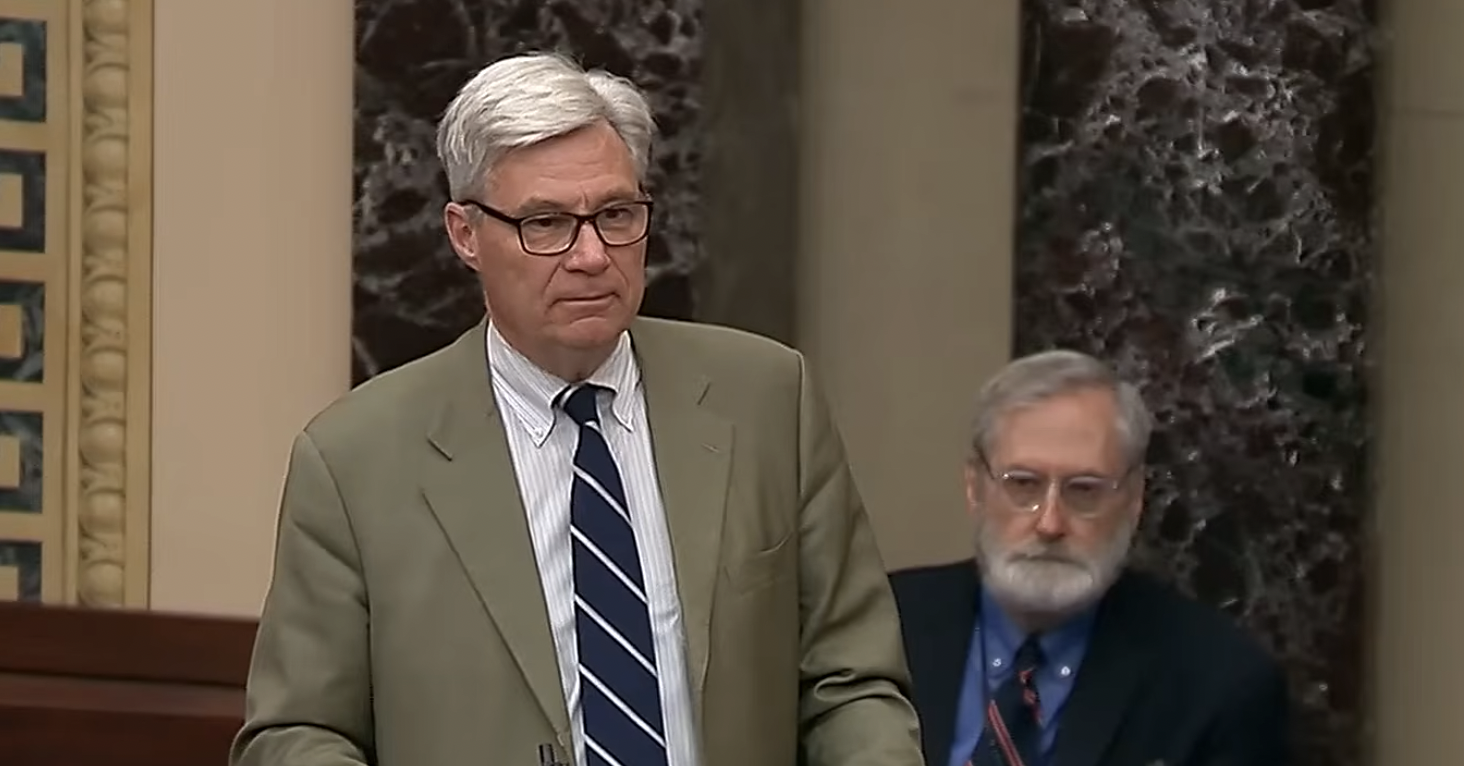
For the Answer, Do Not Consult the April 29, 2026 United States Senate
Properly impatient with the current majority party’s intransigence on climate change, Senator Whitehouse (D-RI) on Thursday sought unanimous consent of the full body for a very simple resolution:
“Sea levels are rising.”
The Senator then explained:
“With regard to a unanimous consent resolution, I’ve tried one before to pursue a simple truth that climate change is real. Earlier this year, I came to the floor and asked my colleagues if they could all agree on that simple scientific fact. Sadly, given the nature of this body, they could not.
“So, we’re going to break it down into smaller bits because the reality of climate change is made up of many, many simple truths. And I hope that by breaking it down piece by piece, I can find areas where my colleagues will agree. Today’s simple truth, sea levels are rising. Can we agree on that?
“The resolution specifically says, recognizing that sea levels are rising at accelerated rates due to humancaused climate change. As global air temperatures rise, obviously so do the temperatures of the oceans. Here is a graph showing the increase in ocean heat content. It’s measured in zeta jewels. Zeta jewels is a very big number. Uh zeta means it has 18 zeros. It’s a billion trillions or a trillion billions depending on which way you want to go about it. To put it at a more practical scale, the entire production of energy by the human species on all of planet Earth adds up to 1/2 of a zedigjle.
“The price we pay for the fossil fuel component of that half zedle of energy is an ocean whose temperature is increasing by around 15 zedles a year. It’s a 30 times magnifier because of the effect of fossil fuel emissions. And as ocean heat content grows, seawater expands. It’s the physical nature of sea water to expands as it warms. And it also melts nearby glaciers. And both result in higher sea levels. combined glacier melt and thermal expansion of water cause global sea levels to rise and the rates are accelerating over time.
“Here is the curve of global sea level rise. It is one of the most unambiguous indicators of what emissions are doing on our earth to our natural systems. Sea level rise has been in going at accelerated rates since about 1863, which lines up right with the dawn of the industrial revolution when greenhouse gas emissions began to rise as we burn coal, natural gas, and oil. Depending on the trajectory of greenhouse gas emissions, sea level rise in the United States could range between two and over 7 feet by the end of this century. That’s a particularly dangerous proposition when you consider that 3.7 million Americans in the contiguous United States live on land less than 3.3 feet above high tide.
“And it doesn’t come up like a bathtub. It comes up and is still subject to tide and storm. So it can be driven ashore at far far higher levels than two feet or over seven feet. Most of the impact will be in Florida, Louisiana, California, New York, and New Jersey. But my home state of Rhode Island and my colleague, Senator Marky’s home state of Massachusetts, will share that unfortunate experience. Sea level rise isn’t just evidence of a changing climate. It has real consequences. 30% of people living in the United States live in coastal areas, which puts them at risk from rising seas, increased flooding, shoreline erosion, and storm hazards. And it’s not just people at risk. 10 trillion dollars in goods and services are produced in coastal areas of the United States.
“Rising sea level will not only cause we call increased sunny day flooding, like when there’s no rain to cause the flooding, it’s just tied in sea level rise, but it will also increase the amount of flooding from storms and from storm surges, and that will cost lives and money. Indeed, it’s already disrupting insurance, mortgage, and real estate markets. I’ve spoken elsewhere about the meltdown in Florida in those markets. Florida was recently described as the biggest loser for real estate values of all the 50 states. And it relates back to this cascade from climate risk to insurance being unavailable or too expensive to afford to mortgages being compromised to um property values taking a hit.
“There are some lessons we should learn from what’s already happened. $ 8.1 billion of the $62 billion ascribed to Hurricane Sandy connects back to the rise in sea levels would have saved $8 billion where the sea level rise not happening everywhere. High water levels that were once rare, one in a hundredyear events are becoming one in 10 or one in fiveyear events. Up to 13 million Americans will face displacement from sea level rise by 2100.
“That’s assuming that all goes smoothly. But all doesn’t always go smoothly. There are tipping points in life. My favorite example is a rowboat. If you put more and more weight in the rowboat, the water goes up and up the side of the boat, and there’s not much change as the water goes up and up the side of the boat. But then you hit a tipping point where the water flows over the gunnel and into the boat. And that’s a big tipping point difference because suddenly it’s not just more and more of the hull down in the water. It’s the whole boat catastrophically falling, flooding, sinking to the bottom of the lake or the sea.
“So tipping points are to watch for. Most ice is found in polar regions. With little as 1.5 degrees Celsius of warming, the Greenland and West Antarctic ice sheets could destabilize. That would be a major tipping point. Our Earth has already warmed 1.2 2 degrees C. So getting to 1.5 is not far away. And Greenland, for instance, is warming four times faster than the global average. So that puts us at the risk of the polar ice tipping point very soon. Sea levels are expected to rise by 20 to 25 feet, not 2 feet to 7.2 feet, 20 to 25 ft. If the Greenland ice sheet melts and an additional 10 to 17 feet if the West Antarctic ice sheet melts, the disintegration of either ice sheet would render major cities uninhabitable and completely destroy America’s coastal communities.
“So, here’s the simple truth. Sea level rise is real. It’s happening. Fossil fuel caused climate change is accelerating its effects. Indeed, it is already disrupting American lives, pocketbooks, and families.
“I ask unanimous consent that the Committee on Commerce, Science, and Transportation be discharged from further consideration and the Senate now proceed to Senate Resolution 551. Further, that the resolution be agreed to, the preamble be agreed to, and that the motions to reconsider be considered made and laid upon the table.”
The Senate Speaker then asked if any Member sought to object, and Senator Ron Johnson (R-WI) rose:
“Reserving the right to object: first of all, let me state I’m not a climate denier. I’m just not a climate alarmist. The Senator from Rhode Island is talking about simple truths. Well, again, the simple truth is there’s no climate emergency. And so, Mr. President, I object.“
. . . . .
In this way, this week, Sheldon Whitehouse, one of the Senate’s most thoughtful and articulate defenders of the Rule of Law, was yet unable to secure its unanimous agreement on a scientific fact of the greatest moment to “The Ocean State.”
It is, in fact, a most benighted state of affairs, one to which we will have occasion to return as we determinatively forge a viable path toward a more secure future.