

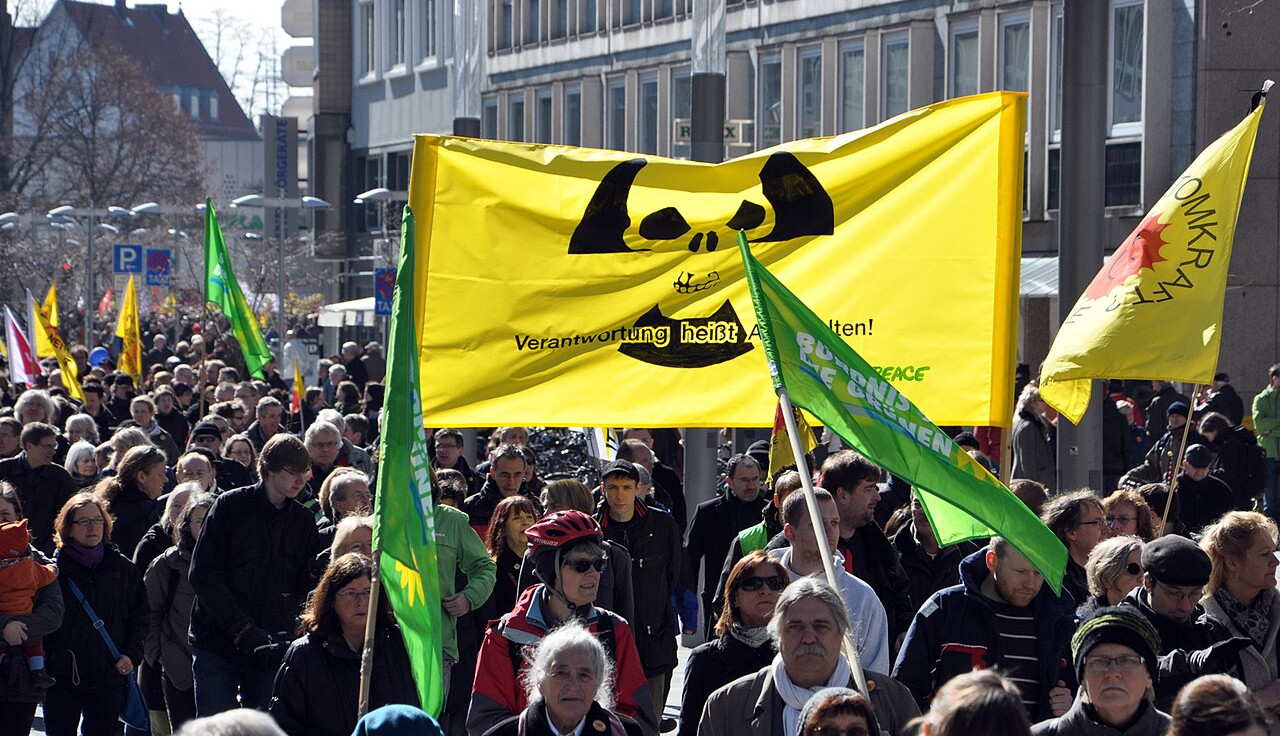
The Eugene Weekly kindly ran my piece today, ‘Protest and Survive’: Observations on the War, Climate Change, and the Rule of Law. In it, I draw connections that seem to me now plainly searing.
For reasons of space, however, the paper did not include my earlier draft’s note of explanation as to the first bit of its title: Protest and Survive, and so I offer that here.
Protest and Survive: Stop Nuclear War, published in 1980 on the continent and the next year in the U.S., was a collected work in which its primary author, the British historian E.P. Thompson, argued that forward deployments of U.S. tactical nuclear weapons to the European border with Soviet-bloc nations was irrational, inflammatory, and escalatory.
His writings inspired the European public in particular to protest the insanity of nuclear war preparations, protests necessary to survive — given that, once begun, a nuclear war can only be lost. But the part of Thompson’s work that I then found especially instructive was its forward, a piece written by former U.S. nuclear weapons strategist turned peace activist Daniel Ellsberg.
In his Call to Mutiny piece, Dan Ellsberg argued persuasively against the myth that the U.S. had not used nuclear weapons since the end of WWII. Instead, as Ellsberg there detailed, every president, from Truman through Carter (with the possible exception of Gerald Ford) had used nuclear weapons without going all the way to command their detonation, that is as an instrument of coercion — in the same way that a mugger might use a gun without ever pulling the trigger.
Of course, guns used at first as mere instruments of coercion become available tools of lethality when the coercion backfires or otherwise fails, just as, in similar but explosively more dramatic fashion, nuclear weapons may well produce widespread death and catastrophic destruction when their coercive use is thwarted and nullified but the coercer fails to back down or otherwise holder his maximal instrument.
Fortunately, in the nuclear weapons context, threatened nations tend to back down, or else presidents doing the threatening tend, once in it, to sober themselves and disengage. But at this writing, our cornered and out-of-touch president appears alternately drunk with his ability to rain down death and destruction on that nation, and angered that Iranian forces are fighting back in multiple directions.
We could use Dan’s voice and wisdom now — as well as that of E.P. Thompson — because the Gulf region plus Israel are littered with nuclear weapons, while both the U.S. and Russia, as I pointed out in my Eugene Weekly article, have integrated the first use of nuclear weapons into their command structures. That means their use is not restricted to deterrence and/ or last-resort use.
I knew Dan a bit, from our time, decades ago, in a Santa Rita, California, jail, awaiting trial for our participation in a mass non-violent civil disobedience action that sought to call attention to the destabilizing counterforce nature of MX and Trident II systems then in development at the Livermore Nuclear Weapons Laboratory. I learned a few things from him in that time, including how to juggle, how best to think about activism, and more. He died, alas, in 2023, but a few years before that he had published his long-awaited work, The Doomsday Machine: Confessions of a Nuclear War Planner. Towards its close, Dan touched also on the horrendous threat that unabated fossil fuels portend, a brewing catastrophe potentially on par in its severity, over time, with nuclear war. I reprint Dan’s final passage here because of the poignant wisdom it conveys, relevant as it is to this day, perhaps especially so:
Is it simply quixotic to hope to preserve human civilization from either the effects of burning fossil fuels or preparing for nuclear war? As Martin Luther King, Jr. warned us, one year to the day before his death, “There is such a thing as being too late.” In challenging us, on April 4, 1967, to recognize “the fierce urgency of now” he was speaking of the “madness of Vietnam,” but he also alluded on that same occasion to nuclear weapons and to the even larger madness that has been the subject of this book: “We still have a choice today: nonviolent coexistence or violent coannihilation.”
We must move past indecision to action. . . .If we do not act, we shall surely be dragged down the large, dark, and shameful corridors of time reserved for those who possess power without compassion, might without morality, and strength without sight. . . .Now, let us begin. Now let us rededicate ourselves to the long and bitter, but beautiful, struggle for a new world.