

Remain I
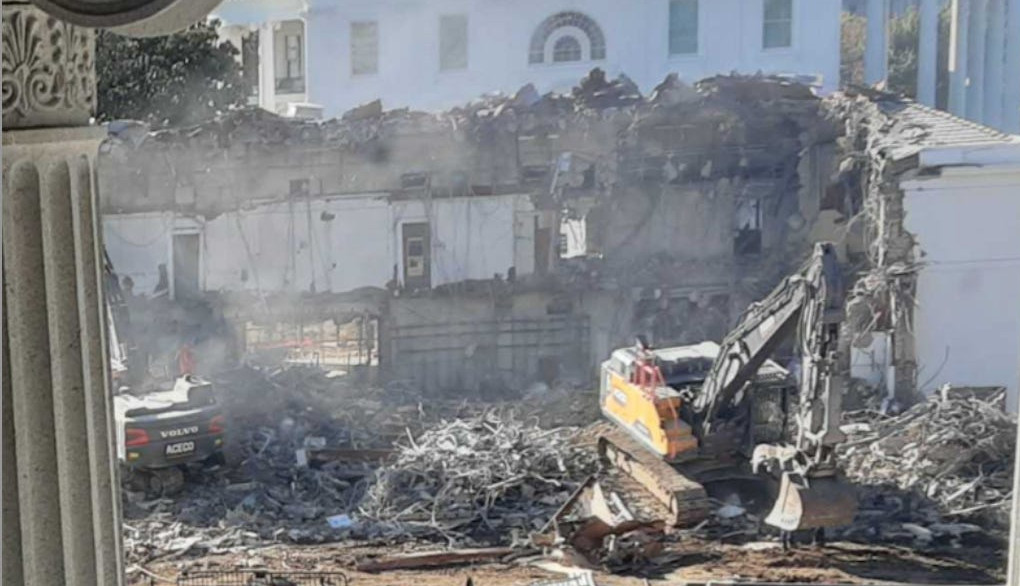
The caption’s wallpaper depicts the demolition of the East Wing, clearing space for a privately-funded, gilded ballroom. It is an instance of a central theme: short-sighted or chaotic despoliation of the public trust, in service to power (or vanity), in patent violation of the law.
Last week, the White House’s pursuit of that theme reached a near apogee, as it announced their determination to unilaterally withdraw the nation from the United Nations Framework Convention on Climate Change.
Toward lawless chaos
We can enumerate a few instances of the building disregard:
- the unlawful federalization of the national guard, to take the streets of blue-state cities;
- the unlawful deportation of alleged immigrants to Salvadoran or other distant prisons;
- the unlawful attack on Venezuela and expropriation of its oil;
- the unlawful exposure of personally-identifiable information heretofore held by federal agencies tasked with confidentiality;
- the unlawful attacks on minorities, the freedom of the press, educational institutions, disadvantaged communities, health and welfare programs, and an independent judiciary.
What was normal is now fraught.
Moreover, at this writing citizens in Minneapolis-Saint Paul are confronting roving bands of masked and armed federal agents. What was normal life is now fraught, as wave after wave of the White House-dispatched men occupy the streets, instilling fear by their home, business, and vehicle sweeps, stops, assaults, confinements, and interrogations, including of innocent residents, and regular application of chemical spray. This federal imposition, too, is unlawful.
Recent Environmental Depredations
Much now depends on the ability of our federal judiciary to stand up and take on this seeming juggernaut of lawlessness and gratuitous harm. In the balance resides democracy and the rule of law, and also the fundamental environmental conditions required for public health and welfare. That is so in part because of recent decidedly anti-environmental moves, including the planned:
- repeal of the Environmental Protection Agency’s mercury and air toxics emissions limits,
- withdrawal of EPA’s Clean Air Act Endangerment Finding, on whose basis the agency, in 2009, at long last, began to restrict greenhouse gas (GHG) emissions from certain sectors, including fossil fuel-powered electric generation stations and internal combustion engine-based vehicles,1
- rollback of the Department of Transportation’s fuel economy standards for light-duty vehicles.
In my view, the federal courts retain ample authority to consider and decide citizen challenges to each of these White House/EPA depredations, though it will not be easy in part because it is all at once.
Still, the wholesale abdication imposed by a recent “presidential memorandum” may reside in a different category altogether. By that action, the White House announced a withdrawal from 66 “International Organizations, Conventions, and Treaties,” all of which, it claimed, “are contrary to the interests of the United States.”
In truth, it is bizarre. How, for instance, is US participation in the International Law Commission at odds with the interests of the United States? Or, for that matter, our support for the work of the Office of the Special Representative of the Secretary General for Children in Armed Conflict? Or US participation in the Intergovernmental Panel on Climate Change?2
An Ultimate Disregard for an Ultimate Objective
There is just one treaty among the 66 international cooperative efforts from which the White House now seeks to withdraw the nation, that is, the United Nations Framework Convention on Climate Change (“the Convention” or UNFCCC).
By its express terms, the Convention, in order “to protect the climate system for present and future generations,” obliges every nation to take action needed to achieve the Convention’s “ultimate objective,” that is, “stabilization of greenhouse gas concentrations in the atmosphere at a level that would prevent dangerous anthropogenic interference with the climate system.”3
The Convention is not the sole source of every nation’s duty under international law to protect the climate system, as the International Court of Justice determined last July, but it does clearly pronounce their affirmative obligation to act.
As readers here well know, the Convention’s “ultimate objective” has not been achieved, as climate-fueled disasters mount year-by-year, and as the global system careens towards tipping points from which there may be no realistic possibility of return.
But withdrawal is no appropriate response to the mounting danger. Instead, the US should remain and strengthen the Convention — including by setting a positive example through domestic action and international cooperation aimed, at minimum, to phase out the production and use of fossil fuels in energy systems.4
At this juncture, regrettably, it is unclear whether the federal courts will consider a challenge to the attempted unilateral withdrawal from the UNFCCC — despite the patently foolhardy nature of the action, and despite the patently undemocratic nature of the President’s arrogation to himself of the power to unilaterally withdraw from it. But they should. After all, although entitled a “Convention,” the UNFCCC has the legal force of a treaty and thus comprises, alongside the Constitution and federal law, “the supreme Law of the Land.”5
The Convention was signed by most nations at the Earth Summit in Rio de Janeiro, Brazil, including, for the United States, on June 12, 1992, by President George H.W. Bush. In his signing statement, Bush I called the Convention “a landmark agreement,” and “a major step forward by the international community in taking action to address global climate change,” requiring, as it did (and does still) “countries to formulate, implement, and publish national programs for mitigating climate change by limiting net emissions of greenhouse gases.”
Less than 4 months later, on October 7, 1992, via a formal “division vote,” the treaty was approved for ratification by the Senate. Not one of the 92 Senators then present rose to oppose the resolution conveying that body’s advice and consent.
Importantly, the Senate has never given its advice or consent to withdrawal from the UNFCCC.
Keeping in mind that, by its terms (UNFCCC, Art. 25), no nation’s exit from the treaty is effective until “expiry of one year” from the date it has filed formal articles of withdrawal with the UNFCCC’s secretariat, the question becomes, during this at least one-year period, What should we do?
The US Senate could, if it chose, pass a resolution of disapproval, or otherwise bar withdrawal. Or else, the present Administration could, at least in theory, change its mind. At minimum, a pressure path of public demand might strengthen a succeeding executive’s resolve to reenter the treaty and pursue corresponding domestic action, perhaps accompanied by bilateral or other international initiatives that, altogether, might help secure the Convention’s ultimate objective.
The question remains open, What should we do? It is one to which we will soon have occasion to return.
At CPR Initiative, we are determined to protect and restore our planet’s climate system. But we cannot do it alone. We invite you to join us in this fight for our common future. Please make your most-generous possible donation today. All financial contributions are tax deductible. We greatly appreciate your support.
- Readers can review our 2025 comments opposing the Administration’s proposed elimination of rules restricting carbon pollution from power plants and from the transportation sector. ↩︎
- The International Court of Justice relied heavily on the IPCC’s 6th Assessment Report when it issued its recent landmark opinion, Obligations of States In Respect of Climate Change. ↩︎
- UNFCCC, Preamble and Art. 2. ↩︎
- Global Stocktake (COP 28 (Dubai) Decision, 1/CMA.5, II(A)(28)(d) (committing the nations to a “global effort” of “[t]ransitioning away from fossil fuels in energy systems, in a just, orderly and
equitable manner, accelerating action in this critical decade, so as to achieve net zero by 2050
in keeping with the science”). ↩︎ - “[A]ll Treaties made, or which shall be made, under the Authority of the United States, shall be the supreme Law of the Land.” US Constitution, Article VI. ↩︎