

On February 27, the Trump II Administration undertook two actions that strike at the heart of the rules-based international order — or what is left of it.
One of these actions was well-publicized, the other, not at all.
The well-reported action was the regime’s decision – rendered, apparently, on Feb. 27 at 3:28 p.m. EST from aboard Air Force One – to launch a war against Iran. The other enormous action undertaken on Feb. 27 – this one entirely unreported, as far as I have been able to discern – was the formal move by the Trump II regime to withdraw the nation from the United Nations Framework Convention on Climate Change (UNFCCC).
The U.S. and Israeli war against Iran commenced ten hours after Trump’s green light, with aerial strikes administered at 9:38 local time on Saturday, Feb. 28, “the first morning of the working week [just as] children arrived at school, employees sat down in their offices, and shops were open. Initial attacks destroyed many military installations and some civilian infrastructure throughout western and central Iran.
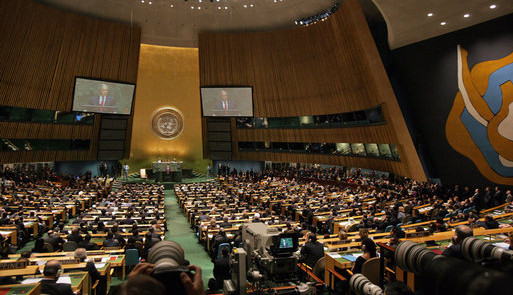
Casualties to date include 175 schoolchildren, ten members of the U.S. military, and also — figuratively — the integrity of the United Nations Charter. The Charter was signed in 1945, after all, “to save succeeding generations from the scourge of war,” and it expressly bars the use or threat of force except in strict self-defense or as directed by the Security Council. That prohibition forms an important basis of the development of international criminal law in the wake of World War II, together with principles derived from the Nuremberg Tribunal — whose judgment defined “a war of aggression” as “not only an international crime [but] the supreme international crime differing only from other war crimes in that it contains within itself the accumulated evil of the whole.”
As for the UNFCCC, a helpful interactive timeline can be found here. In this space I recently reviewed the U.S. Senate’s role in approving President H. W. Bush’s ratification of the treaty. From a diplomatic perspective, it is beyond the pale for the U.S. now to withdraw from the world’s climate treaty, particularly in such an offhanded way — via a unilateral “presidential memorandum” announcing the nation’s exit from a batch of 66 international efforts, and with no public hearing, no congressional debate, and no proposed replacement.
I learned of the formal act of U.S. withdrawal, dated Feb. 27, only by monitoring the UN Secretary General’s depository notifications page. It denoted, on that date, that the U.S. had withdrawn. But over a 7-week period, the question whether the US would formally withdraw remained open. In particular, the White House’s Jan. 7 “presidential memorandum,” entitled “Withdrawing the United States from International Organizations, Conventions, and Treaties that Are Contrary to the Interests of the United States,” specified that the term “withdrawal,” for purposes of that memorandum, meant “ceasing participation in or funding to those entities to the extent permitted by law.”
With respect to the UNFCCC, then, the State Department could and should have carried out the memorandum’s directive simply by “ceasing participation in or funding” the UNFCCC. On net, then, it appears that in formally withdrawing the U.S. from the treaty, rather than, for instance, merely ceasing to send a US delegation to the annual Conference of the Parties, Secretary of State Marco Rubio went considerably further than he was instructed by Trump.
The larger issue is that the executive branch’s unilateral withdrawal tramples the Constitution’s dual investiture of authority for “treaty making.” See On Unilateral Withdrawal. Specifically, the President’s authority to “make treaties” is subject to an express condition precedent in the Constitution, namely that the President will have first received “the Advice and Consent of the Senate,” with at least “two thirds of the Senators present” concurring. Consistent with that constitutional instruction, President George H. W. Bush submitted the UNFCCC to the Senate, for its deliberation, on September 8, 1992. He did not simply jump over the constitutionally prescribed step to first secure the Senate “advice and consent” and unilaterally sign and submit the instrument of ratification to the United Nations.
Bush did not simply jump to unilaterally sign and submit the UNFCCC instrument of ratification to the United Nations.
The same expectation of Congressional concurrence or, at least, Senate consent, should apply to the contemplated withdrawal from a duly-approved treaty. As Yale Professor of Law Harold Koh strongly argued, as far back as 2017, “the Constitution requires a “mirror principle,” whereby the degree of legislative approval needed to exit an international agreement must parallel the degree of legislative approval originally required to enter it.”
In my view, that mirror principle must be deemed implicit in the Constitution, because otherwise the Senate’s treaty-making role can be breached the day after it is exercised. [That said, there may be rare circumstances in which the mirror principle would need to be ignored, such as where a clearly demonstrable actual national emergency requires executive action that a current treaty might not accommodate.]
The Supreme Court has not yet substantively weighed in on the constitutional question, that is, whether, for a treaty whose implementation or abandonment is not a matter of national security, at least some level of Congressional consent is required before the President can withdraw from it. And if so, what level of congressional support is required.
Indeed, I think the Court might be most likely to take the matter up with respect to the Trump withdrawal from the UNFCCC if one or both Houses of Congress were to advise the President, and the nation, that it does not approve of U.S. withdrawal from the world climate treaty. There is, indeed, a bit of time for the House and Senate to consider such action since, as the Secretary General advised, the U.S. withdrawal will not “take effect” until Feb. 27, 2027.”1
For that reason, among others, then, CPR Initiative has commenced Remain-In: A Petition to the United States Congress. Every member of the CPR Initiative Board of Directors has signed this Petition, and we urge readers and supporters, along with their friends, colleagues and affiliated organizations to sign and support as well.
It is, quite frankly, a heavy lift, but among the right and necessary things to do at this highly fraught moment.
- The UN depository notice observed, further, that the one-year timeline was “in accordance with paragraphs 1 and 2 of article 25 of the Convention, which read as follows: “1. At any time after three years from the date on which the Convention has entered into force for a Party, that Party may withdraw from the Convention by giving written notification to the Depositary. 2. Any such withdrawal shall take effect upon expiry of one year from the date of receipt by the Depositary of the notification of withdrawal, or on such later date as may be specified in the notification of withdrawal.” ↩︎