


(Note: Reprinted with the kind permission of the Eugene Weekly.)
Until recently, most citizens scarcely imagined that a Trump II assault on the rule of law would extend much beyond a targeting of civil liberties, environmental enforcement, civil service protection, the social safety net, public education and the integrity of federal elections.
Clearly, we suffered from a lack of imagination.
On Feb. 28, commencing a war of choice, U.S. and Israeli military forces bombed multiple sites throughout Iran. Its twinned strategic purpose — beyond distracting domestic audiences from recurrent scandals implicating Benjamin Netanyahu and Donald Trump — appears to be to degrade Iran’s military capacity and to “take out” its political leadership. Superego may be involved too, as Trump likely was repelled by the thought that Bibi would one-up him on the world stage.
Is the commitment to peace and the rule of law now entirely antiquated, a quaint vestige of the past wherein “international niceties” were taken seriously? Let me lay my cards face up: The exact opposite is true.
The principles and norms of the charter and international law are as relevant, and as needed, now as ever before. U.S. officials launched this thing unilaterally, with no United Nations Security Council authorization, no congressional declaration of war, and no meaningful public debate as to its necessity. Instead, they jumped to execute a presidential whim, with little consideration of likely risks.
For well over a week, at this writing, the president, the secretary of state and the secretary of defense have issued varying, shifting and logically absurd justifications for their initiation of this damnable war. But at least their befuddlement helps explain why the president’s obsequious supporters, scrambling for relevance, now insist that our nation is not at war at all. Rather, they say, we are in a “major combat operation,” or some such nonsense. A Florida congressman even argues that it cannot be a war that we are in, because “Congress declares war, and we haven’t declared war.” George Orwell would have taken note.
But really, it sounds like war.
Take, as a prime instance, the March 4 blood-thirsty pronouncements of self-proclaimed “Secretary of War” Pete Hegseth: “America is winning decisively, devastatingly and without mercy…. we will fly all day, all night, day and night finding, fixing and finishing the missiles and defense industrial base of the Iranian military, finding and fixing their leaders and their military leaders. …”
“And Iran will be able to do nothing about it. B-2s, B-52s, B-1s, Predator drones, fighters controlling the skies, picking targets, death and destruction from the sky all day long. We’re playing for keeps…”
“Our rules of engagement are bold, precise and designed to unleash American power, not shackle it. This was never meant to be a fair fight, and it is not a fair fight. We are punching them while they’re down, which is exactly how it should be.”
Impertinent though it may seem, we need to raise some questions. Why, for instance, if our “rules of engagement” are “precise,” did several of the first air strikes hit the Shajareh Tayyebeh elementary school for girls in Minab, in southern Iran, killing 168 to 175 young people, according to The New York Times?
And why, for that matter, did Israel’s first strike, apparently coordinated closely with the U.S. central command, seek out and kill Iran’s Supreme Leader Ali Khamenei? By all reports, Khamenei and his regime have been brutal, including by their murder of thousands of unarmed protesters in recent months. And yet Khamenei and his negotiators were cooperating on the overriding question of nuclear weapons acquisition even after the Trump I regime terminated the Iran Nuclear Deal — the Joint Comprehensive Plan of Action of 2015. Indeed, the day before the war commenced, the U.S. and Iran were reportedly close to a deal on uranium stores — the immediate object of their bilateral talks, and the Omani mediator explained to U.S. officials that the Iranians were also open to discussion concerning ballistic missiles.
The risk of escalation cannot be ruled out. Hegseth proclaims that “four days in, we have only just begun,” and, for his servile part, North Atlantic Treaty Organization Secretary General Mark Rutte rushed in to announce the “widespread support” of member nations. Meanwhile, Iran has launched retaliatory strikes at sites in nations aligned with the U.S., including Saudi Arabia, Iraq, Oman, Bahrain, Kuwait, United Arab Emirates, Qatar, Azerbaijan, Jordan, Cyprus and Israel, and at tankers carrying crude or natural gas through the Strait of Hormuz.
Vastly compounding that risk, Russia reportedly is engaged in supplying the Iranians with targeting intelligence concerning regional U.S. assets.
Even a nuclear exchange cannot be ruled out, as the U.S. has long declined to commit to a no-first-use policy and, since 1993, Russia has refused as well — as the late analyst Daniel Ellsberg explained in 2017. The unpredictable nature of a widening war in this heavily militarized and nuclearized region could amplify the lethal intemperance of an increasingly addled and politically cornered president. All in all, the risk of backfire, collateral damage and escalation — even to the point of catastrophe — is unacceptably high.
And finally, at least for this part, a further set of questions: Is “punching them while they’re down” really “how it should be”? Does such imperious venom serve any reasonable end? It all reflects, in my view, a diminution and degradation of our politics, at a time when wisdom and clear thinking is required.
WHITHER INTERNATIONAL COOPERATION
A world at war or, at least, another major regional war — particularly one implicating energy resources that remain essential for global development — is not conducive to the type of international cooperation that is needed to resolve other major global problems.
Fifty nations, including the U.S., recognized this fact in signing the United Nations Charter at the end of World War II, in San Francisco, on June 26, 1945. Secretary of State Edward R. Stettinius Jr. signed for the U.S. that day, while President Harry Truman formally signed on August 8, 1945, the final stage of the U.S. ratification process as provided by the U.S. Constitution. A total of 193 nations have signed on to date, recognizing, at least formally, that peace and security are necessary to secure the level of cooperation needed to solve “international problems of an economic, social, cultural or humanitarian character.”
Forty-seven years later, when the nations again came together — this time, to combat dangerous global climate change — they appealed once more to the principle of international cooperation that underlies the UN Charter and international law. Accordingly, the United Nations Framework Convention on Climate Change called for “the widest possible cooperation by all countries and their participation in an effective and appropriate international response.”
The UNFCCC further obligated each signatory nation to “protect the climate system for the benefit of present and future generations of humankind, on the basis of equity and in accordance with their common but differentiated responsibilities and respective capabilities.”
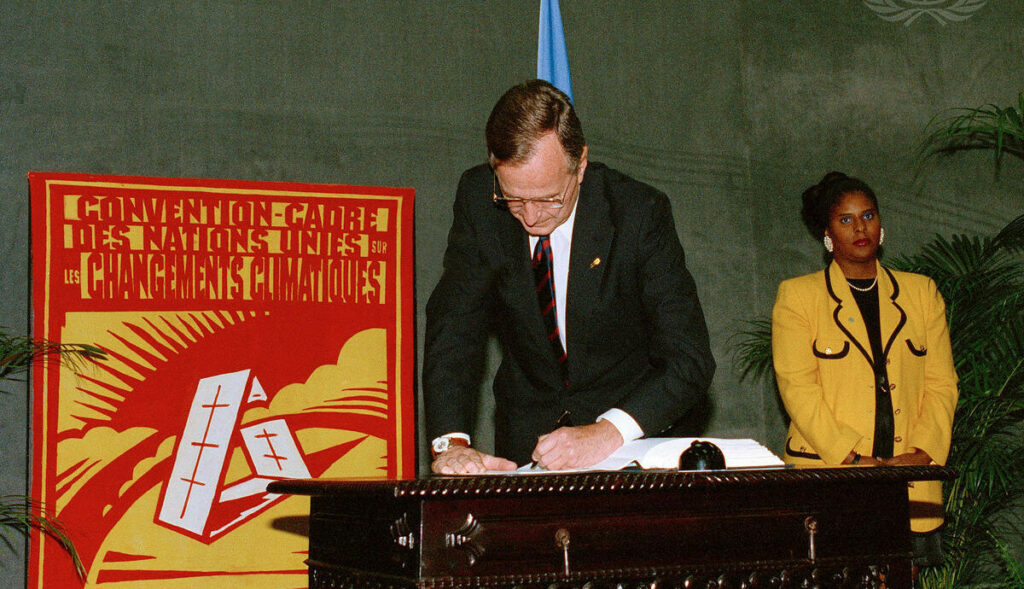
Original signers included President George Herbert Walker Bush of the U.S., who traveled to Rio de Janeiro for the purpose. Consistent with the demands of the U.S. Constitution, the Senate then provided its advice and consent in favor of ratification, on Oct. 7, 1992, by a margin of 92-0. Six days after that, on Oct. 13, 1992, Bush signed “the instrument of ratification,” formally entering the nation into the UNFCCC. Bush deemed the treaty “the first step in crucial long-term international efforts to address climate change,” one that is “comprehensive in scope and action-oriented.”
Consistent with the UNFCCC call to action, and pursuant to the promise of the federal Clean Air Act “to protect and enhance the quality of the Nation’s air resources to promote the public health and welfare,” a handful of citizens and states later petitioned the U.S. Environmental Protection Agency (EPA) to restrict emissions from light, medium and high-duty vehicles and their internal combustion engines. But in service to vested interests, an industry-captured EPA resisted for years. Litigation ensued, culminating in a Supreme Court case concerning whether the EPA needed to decide if greenhouse gas emissions endanger health or welfare in the U.S.
In the seminal 2007 decision, Massachusetts v. EPA, a narrow majority of justices said “yes.” Two years later, EPA finally issued its Endangerment Finding and, on that basis, imposed restrictions on GHG emissions from the vehicle sector.
Fast-forward, past multiple fits and starts, to the Trump II/Lee Zeldin EPA, and its proposal to repeal both the endangerment finding and the vehicle emissions standards. EPA’s proposal was reckless and unlawful, in the view of many, including the nonprofit I founded, Climate Protection and Restoration Initiative (CPRclimate.org), as we detailed on Sept. 22, 2025, in comments to the rule-making record.
I remember, having completed that filing, wishing to tell my father of its strength, as he cared deeply about our common future, but by then Arnold Galpern was on his deathbed, unable to fully comprehend. Nonetheless, I felt he knew, at least in some spiritual sense of the word.
Alas, the Trump/Zeldin team, as anticipated, proceeded with its repeals in a final rule issued Feb. 18. Although one after another account in major news outlets got the story substantially wrong, the final EPA action demarks a decided retrenchment in U.S. environmental law. That is true even though arguments employed by the agency amounted, legally speaking, to a house of cards, particularly EPA’s contention that U.S. vehicle emissions, comprising a small share of total global emissions, are too puny to restrict.
We thoroughly countermanded that absurdity in our September comment, as did the International Court of Justice, in its seminal decision of July 2025, concerning “The Obligations of States in Respect of Climate Change.” EPA’s repeal rule is now on appeal.
Not content to terminate our nation’s modest steps, to date, to combat dangerous climate change, the Trump II regime seeks also to undermine the international climate change treaty system. Accordingly, it has withdrawn from the Paris Agreement to the UNFCCC, effective Jan. 27, and, on Feb. 27, it withdrew from the foundational UNFCCC itself — again, by unilateral diktat, with no congressional resolution of support, and with no concern for the additional damage to the planet that will ensue.
We should observe, here, that the UNFCCC is a treaty, and the Constitution provides that treaties, like constitutional provisions and federal statutes, comprise the Supreme Law of the Land. Because the Constitution mandates that the president “take care that the laws be faithfully executed,” it is not his province to repeal, withdraw from or otherwise ignore constitutional provisions or statutes. Neither, then, should he be able to unilaterally withdraw from Senate-approved treaties, like the UNFCCC.
COMMON DENOMINATORS
As to Trump’s war on Iran and his unilateral withdrawal from the world’s climate treaty: What have they in common?
It is simply this. In each case, the Trump II team has arrogated to itself authority that the law strictly conditions on the prior approval of other authority, or where specific conditions provably obtain.
Thus, in the case of war, a president cannot lawfully order U.S. forces to attack another nation, unless it had attacked us first — or was rationally determined to be imminently about to attack. And even then, U.S. military action must be pursuant to an advance declaration or, at minimum, rapid subsequent congressional authorization.
Likewise, in the case of a duly approved treaty, the president cannot lawfully abrogate it, barring some urgent circumstance implicating national security or the like, without advance approval from Congress — and even then, any abrogation must be pursuant to the timing and notification requirements of the treaty itself.
After all, the president is not a king, even if the Supreme Court recently let Trump slide with respect to criminal acts undertaken in the course of wielding presidential power.
Under our Constitution, Congress can stand against presidential overreach. That is precisely what several members of Congress are seeking to do, in their struggle to pass a bipartisan War Powers Resolution. Their efforts merit our support, though they did not succeed in their attempt earlier this month.
Similarly, rights guaranteed by the First Amendment, as well as those “reserved for the people,” enable ordinary citizens to petition Congress to halt or reverse the Administration’s attempted unilateral withdrawal from the UNFCCC. We are doing this now, and every reader can sign on to that initiative at CPRclimate.org.
Beyond these efforts, there will arrive, in the run-up to our nation’s 250th anniversary, any number of opportunities to support democracy under the rule of law, over autocracy and its repressive pretensions. Some of these may responsibly be grasped if pursued with dignity, forethought, situational awareness and in strict adherence to the principle of non-violence.
Dan Galpern of Eugene is founder, executive director, and general counsel of Climate Protection and Restoration Initiative (CPRClimate.org).