

In Re Coal: Part I of VI
The normally astute Paul Krugman recently proffered a large, if common, error of metaphor at his Substack site.
The writer was arguing, in part, that the U.S. government’s deployment of enormous battleships to the Persian Gulf is entirely foolhardy, in light of their high vulnerability to Iran’s responsive use of relatively inexpensive drones.
In support of that position, though without citation, Krugman averred that “there is an overwhelming consensus among military experts that giant battleships are as obsolete as, well, coal power.”
While I am no military strategist (but then again, neither is Krugman!) I doubt that the forward deployment of the US flotilla retains no net strategic utility. But what I am fully sure about, here, is that coal is not obsolete. Not yet, at least. And further, no amount of wishing will make it obsolete.
Coal is not obsolete. Not yet. And no amount of wishing will make it so.
Indeed, coal, widely recognized as “the dirtiest fossil fuel,” continues to account for more than 30 percent of electricity generation worldwide, as a global dataset maintained by the energy think tank Ember illustrates.
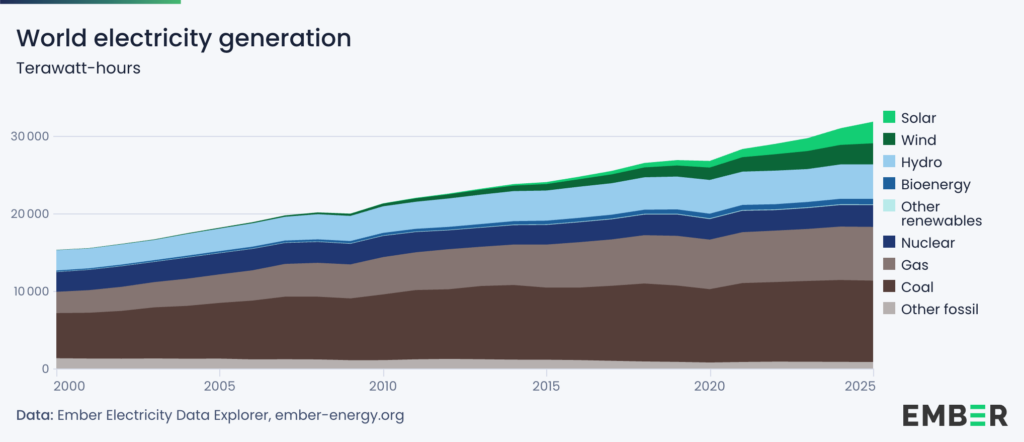
Moreover the U.S.-Israel war against Iran itself has served, if unwittingly, to advance coal’s position in the world energy market. A number of Asian nations, in particular, are doubling-down on their already heavy reliance on coal for energy generation – as “[s]oaring gas prices have coursed through the coal market.”
In a LA Times report some six weeks back, an analyst with Rystad Energy observed that, while “[c]oal is already the dominant fuel in Asia’s power mix, making up well over 40%-50% across the region, what is accelerating now is gas demand destruction: LNG is simply unaffordable for price-sensitive buyers.”
“What is accelerating now is as demand destruction.”
As well, a recent article in Heatmap similarly, if more cheekily, described the “Strait of Hormuz disruption” as “gravy” for coal producers.
Even in the U.S., more than 15 percent of electricity is still generated by the burning of coal, a fuel that is widely considered to be emblematic of the 1800s. Moreover, our domestic production is currently helping feed the increasing worldwide appetite for coal since, according to the U.S. Energy Information Administration, the U.S. is a net exporter of coal (exporting more than we import).
The rub in all this is not only that the continued utilization of coal disproportionately accelerates global warming, but it is that coal utilization leads to illness and premature death in other, more direct ways. A convenient graphic from the folks at Our World in Data illustrates the point: coal pollution imposes a direct and disproportionately heavy burden on human health, as measured in deaths per terra-watt hour of power generation. Particularly as compared to renewable and nuclear energy.
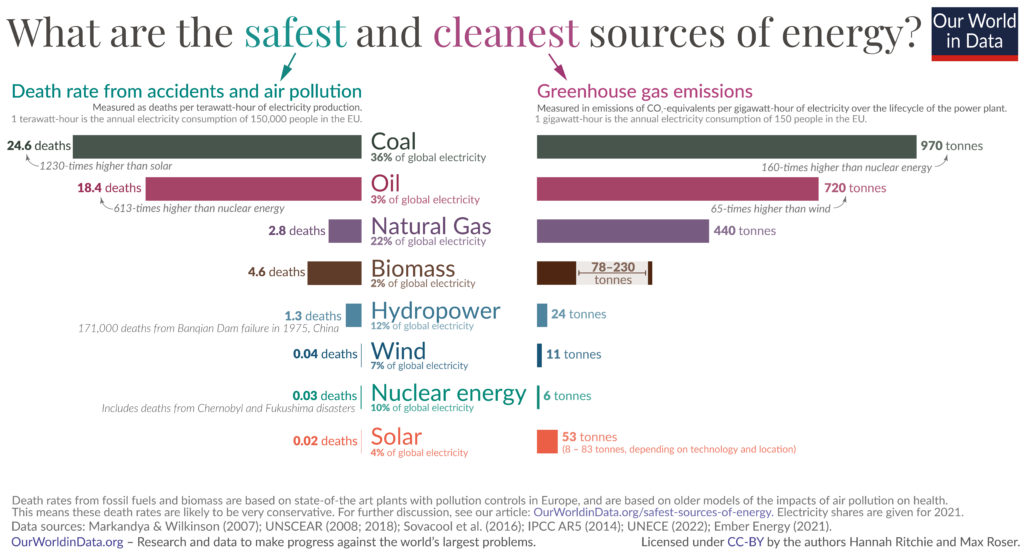
And the fine print in the chart is important, denoting that its reported death rates “are based on state-of-the-art plants with pollution controls in Europe” and “older models of the impacts of air pollution on health. This means [that] these death rates are likely to be very conservative.”
These data implicate policy questions whose consideration, in turn, merit a deeper dive into the public health consequences of fossil fuel production and utilization. In particular, as to the lifecycle of coal.