
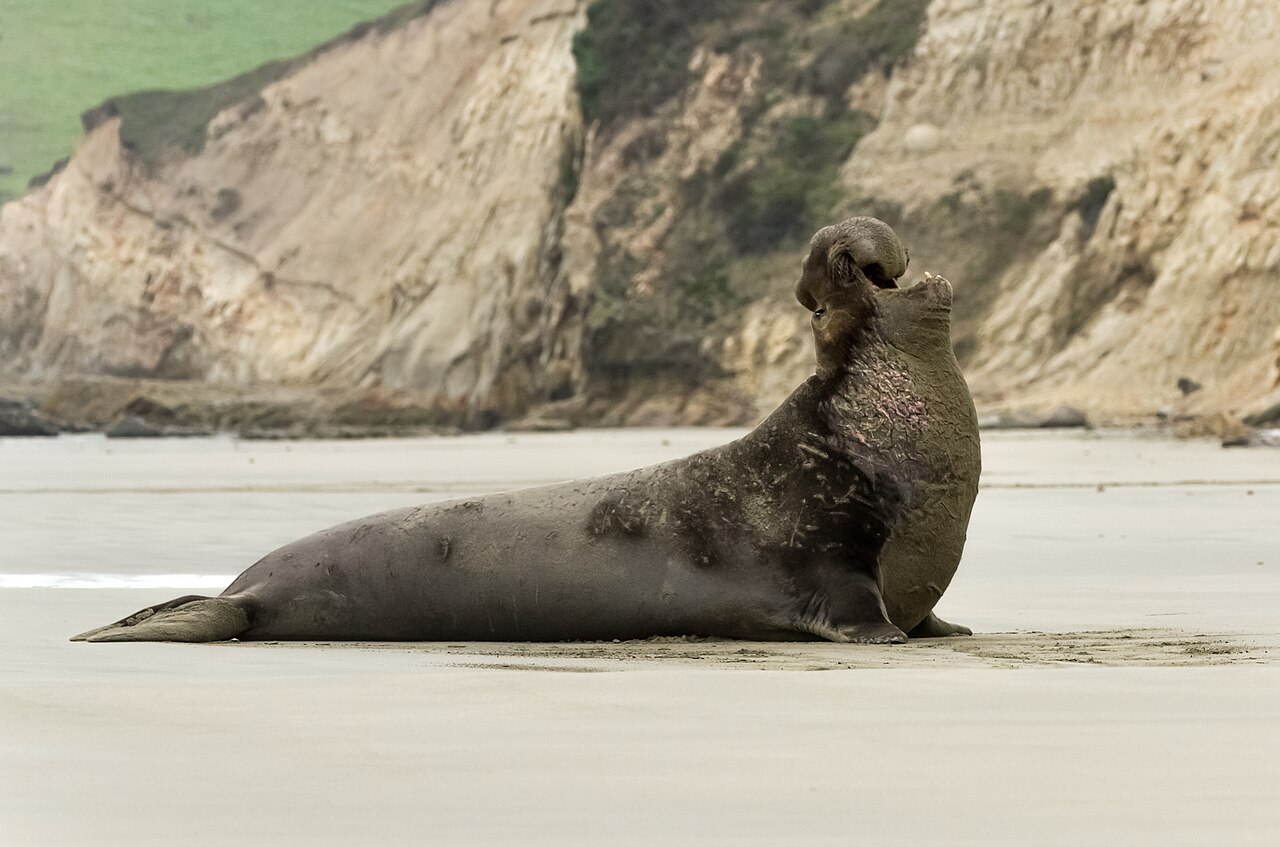
The behemoth was smack dab in front of me. Unforgettable on reflection, in the moment I mistook it for a boulder.
It was years back. I was ambling north, as the sun set on my left, along a rocky shore, near Half Moon Bay, California. He lay across my path, 16-18 feet, stretched, and at least 4 feet tall at his middle (~13-14 feet in girth, I’d say).
I set about to hop that “boulder,” but paused at the last as it stirred, and then, with disdain, let out a marked harumph from its upper end.
In the 19th century, the northern elephant seal was hunted nearly to extinction, taken for its blubber to be converted to oil for lamps and as industrial lubricants. According to an account by the San Diego Natural History Museum:
So great was the slaughter that by the 1880s, the species was considered extinct. It was [therefore] a great surprise when a small population of the seals was found in 1892 on Guadalupe Island, an isolated, rocky piece of land some 200 miles off the coast of Baja California.
Left alone except for a few scientific expeditions over the next 30 years, the population slowly increased to a still dangerously low 264 individuals. Greatly helped by the Mexican government giving full protection to the seals in 1922, the elephant seal’s numbers had increased to between 8,000 and 10,000 in the late 1950s.[1]
In 1972, the U.S. enacted the Marine Mammal Protection Act. That Act did not save the northern elephant seal – the Mexican national government had already worked that miracle — but the U.S. statute clearly aided its recovery. The most recent population estimate that I can find is for 2023: 194,907 elephant seals in total, the midpoint of a 95% confidence interval ranging from 170,185 to 233,677.
The Act, with certain limited exceptions, prohibits the “take” of any marine mammal either “on the high seas,” or “in waters or on lands under the jurisdiction of the United States.” 16 U.S.C. 1372 Sec. 102(a). In turn, the Act defines “take” to mean “to harass,” among other things, with the term “harassment,” again in turn, meaning “any act of pursuit, torment, or annoyance which [among other things] has the potential to disturb a marine mammal . . . in the wild by causing disruption of behavioral patterns, including, but not limited to, migration, breathing, nursing, breeding, feeding, or sheltering.”
Unabated climate change increasingly disturbs more than one part of the lifecyle of these land and sea-dwelling marine mammals. As an analyst with the Point Reyes National Seashore Association put it in 2022, “climate change is the driving cause behind beaches becoming less hospitable for elephant seals.”
In particular, along the western U.S. coastline elephant seals need to haul out on shore, during specific seasons, variously to give birth and to molt. But the rising seas threaten their favored spots – beach strips backed by cliffs that function to keep human admirers and other nuisances at bay.
One recent video, shared on social media, depicts part of the problem, as a female and her pup struggle at the water’s edge. The 20-second scene was captured by Friends of the Elephant Seal, a public interest organization. In its caption, the group observes that “[s]eals face rising air and water temperatures, shifts in the location of their prey, and loss of beach habitat from sea level rise. Because of that habitat loss, there will be higher chances of elephant seals interacting with humans as they seek out new breeding/resting areas.”
The non-profit then advises viewers that they can help by reducing their carbon footprint, by walking or cycling when possible, by shopping for locally grown produce, and “by reducing single use plastics and choosing to reuse.”
All good things, to be sure.
I would add, however, that wider action is also required, given that the rising seas are a local manifestation of the planet’s energy imbalance, which imbalance, in turn, is driven by the exploitation and burning of fossil fuels. Accordingly, we need to act nationally and globally – including by remaining-in and strengthening the world’s climate treaty.
To save the northern elephant seal, including their pups, we need to save the planet.
[1] See also, https://www.nps.gov/pore/learn/upload/resourcenewsletter_elephantseals.pdf